Monday, March 17, 2014

Cumberland Island part 2

Weds, 12 Mar 2014-   

My alarm went off at 6 am and before long I was moving down the trail again in the dark with the plan to catch sunrise over the beach.  Fortunately the trails are straight and wide, and I had been able to get a GPS marking the day before of my destination so I was able to navigate there in the dark.  The weather stymied my vision of a glorious sunrise, rather I got something overcast and subtle.  But I was able to watch the storm blowing out into the Atlantic with its lightning strikes. 


Looking south down Cumberland Island:
 After it got pretty well light out, and I had cooked up breakfast (oatmeal and hot tea on the beach, mmm), I turned north.  I haven’t mentioned it before now, but I had started to realize the day before, and much of the rest of this day would further prove and the picture above gives some indication, that this is by far the wildest beach I have ever been on.  I ended up hiking 6½ miles up the beach to the northern-most tip of the island, and every bit of it was glorious nothing!  I didn’t see any buildings, hear any cars, or even encounter a single human.  There was nothing but sand, surf and dunes around me.  And lots of wind.  The weather was still moving through, so I had band after band of clouds sweeping over, but fortunately no rain.  There were lots of birds working the beach or the water, and a few dolphins just offshore at times.  I was surprised at how firm the sand was.  It was packed down almost as hard as concrete, the walking was sure easy!  Some of the scenic shots- 


This is a snapshot of the dune ecosystem.  One of the toughest but most fragile communities out there.  All of these plants survive in soft sand that does not retain any moisture, meanwhile facing the full force of any storms or hurricanes that come blowing off the ocean.  It makes for a tenuous life.


Through this trip, I had started to focus on the patterns that I could find around me.  Here are a few of them.  This is a little tidal stream, mixing brown organic soil with white sand.  It makes me think of a slab of marble, or maybe a marbled cake.


A cloud from my first night on the island watching the sun set.  Does anyone see the Pegasus?


Sand ripples.  The ocean is off to the right of the picture.


Eventually I made my way back to a dune crossing and went back to the Sound-side of the island.  I came across this pine tree.  This is what I call perseverance- 


Unfortunately I think the tree is going to lose sooner or later.  I saw some skeletons of other trees that had already lost the battle.


I finally made it back to camp, after 11 hours afoot.  I calculated I hiked 17 miles today.  Along with my mileage the day before I was up to 29 miles and my feet were feeling it.  The worst part was knowing I had a lot of hiking to do the next day just to get back to the boat! 


When I turned in for bed that night, it was very warm.  Around midnight the wind started to howl and temperatures started to drop.  At one point I could hear either a whole tree or a large branch come crashing down out in the forest.  After a somewhat scary encounter with a falling branch in Great Smoky Mountains National Park a couple years ago, I have a solid fear of large branches falling on me while backpacking, so hearing things crashing didn’t help!


Thurs, 13 Mar 2014- 
I woke up at 6 am again.  My feet were super tender, but I wasn’t going to miss the opportunity for another sunrise, so I made the trek back over to the beach.  The skies were clear, but the wind was still blowing strongly so I had on everything I’d brought including my rain pants which were handy for blocking off the wind and providing a little extra warmth.


The wind blowing the tops of the waves back and loose sand across the beach.


The soft curves of sand dunes and shadows in early morning light.


After enjoying the sunrise and breakfast again, I hiked back and broke camp.  I started to hobble my way back to civilization.  Along the way I came across this tree- 


There's one not visible, but there are four trunks coming off the base, which itself has to be 8 feet across.  I’m not sure if this one tree or four that merged together, but it was huge!


And, I finally got close enough to some to get an obligatory photo- 


My feet required I take more and more frequent breaks, but I eventually got back to Sea Camp.  I had a couple hours to kill before the ferry took off, so what did I do?  I hiked down to the other dock and to the Dungeness ruins.  I figure pain is temporary, but I may not get another chance to see those ruins ;).


The Dungeness ruins are another Carnegie mansion, last occupied by Lucy Carnegie in 1916.  I’d heard the building had burned and this is what is left of it.  It is massive in scale.  When I look at it, I see this as visceral evidence of what the Gilded Age was really all about, having your vacation mansion on your private subtropical island.  I also keep thinking of Great Gatsby, but I imagine the people here were far more Victorian in nature.


The ride back to dock was uneventful, as was the drive back to Crooked River.  Today I hiked around 13 miles, giving me a trip total of 42 miles in three days.  That's a lot of walking, but fortunately almost all of it was on packed soil and the island is very flat so it was pretty easy.
After three days without, the shower I got was pretty darn nice!


Friday, 14 Mar 2014- 
Sometimes you get lucky.  Temperatures this morning were 35 degrees.  I’m glad I was car camping and not still in the back country.  I had more covers to sleep with, more coats to put on, and was able to get in the car with a nice toasty heater.


The goal for today before driving home was to visit what is probably the most well recognized name in Georgia- the Okefenokee Swamp.  I went in at the Suwanee Canal Recreation Area, and drove down the Wildlife Drive.  Not all of the National Wildlife Refuge is swamp, there are also upland areas as well, mostly longleaf pine forest- 


This is a textbook example of what longleaf pine forest should look like- tall pine trees widely spaced apart with a low understory that is frequently removed by fire.  If you look at the bottom of the above photo, you can see this area was burned very recently. 


I made my way out to the Chesser Island Boardwalk, a ¾ mile raised trail that ends at a 40 foot tower.  The original boardwalk was built in 1969, but it was burned completely in 2011 during the Honey Prairie wildfire.  There was signage that said the boardwalk had survived several wildfires in the past, but this time around the drought was too intense and the fires were too strong. 


I never got to see it before the fire, but it is amazing to me to consider that before 2011 those two pictures would have been of a closed forest canopy.  The change must be shocking for someone who had seen it previously.  The boardwalk has since been rebuilt, this time with Trex boards, which are made of plastic, so they should last into perpetuity.  And they installed a sprinkler system with about 90 sprinkler heads to deal with any fires in the future as well to protect the investment.


At the end of the boardwalk is the tower.  The views up there are incredible.  I took the opportunity to use the panoramic picture function on my iPhone, this is about a 180 degree photo- 
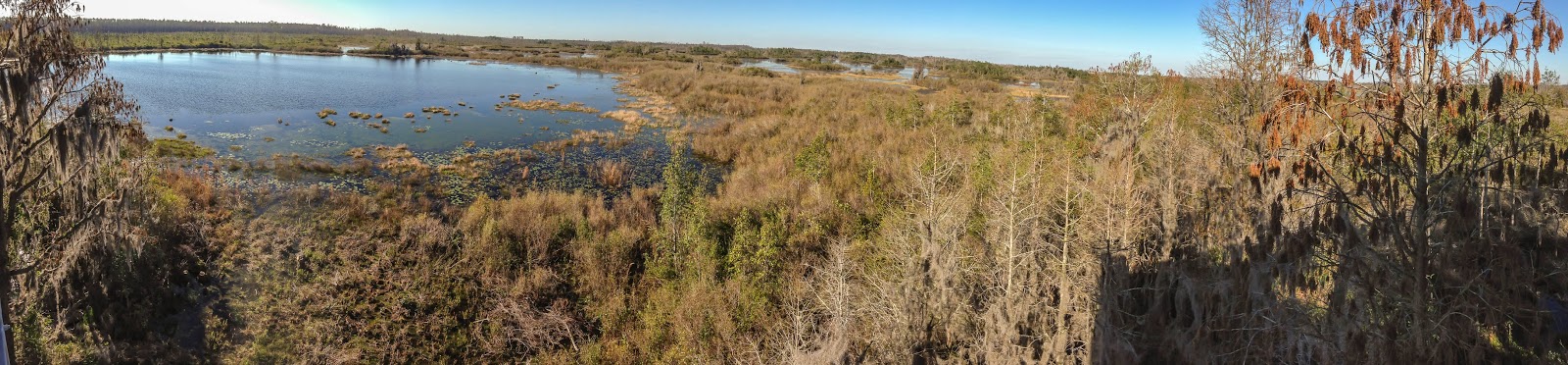


To really get the full effect and see this picture larger click here

After that, I made the long drive from south Georgia back home, even getting the pleasure of some Atlanta rush-hour traffic to welcome me back.  Normally I eat a very health-conscious diet, and while I was backpacking my diet was pretty spartan, mostly things that could be made with boiling water or eaten plain.  I couldn't help it but for lunch I stopped at Sonic for a double cheeseburger, fries and a cherry limeade.  I say this with no shame, it was damn good!


Normally I close with a sunset shot, but I really didn’t get any of those, but I did get a pretty nice sunrise photo from my second morning on Cumberland Island, so I’ll leave you with that.  Thanks for reading, Brandon.

Wednesday, June 12, 2013

Trinidad & Tobago Part 2


DAY 3

The next morning, Debbie and I took a walk with Molly on another trail to look for the third reason bird watchers visit Asa Wright: Bearded Bellbirds.  These birds are part of a group called cotingas.  There are some bellbirds which do make a noise that sounds like the ringing tone of a bell.  The Bearded Bellbird, however, does not sound like that.  It sounds more like “kong”, although it is extremely loud!  I had looked for them on my own the day before, and heard plenty but got not even a glimpse of them.  When I told Molly this, she gave a coy look and said she thought we could probably find one.  Later she told us there are a few on the property which have favored perches and are slam-dunks to get a look at!  In fact, the old one has been there so long and so consistently they have named him George.

Here’s one, you can see the wattles of his “beard” hanging down:


Along the way, we stopped by a lek of Golden-headed Manakins. A lek is a place where male birds gather to compete for female attention.  Leks are persistent for long periods of time, sometimes many years.  Rather than express aggression to one another, males try to outperform each other, whether that be “dancing” or whatever.  Notice these two guys here are very distinctively not looking at each other.
  

Back around the main building, there were a few other birds to be found, like this Cocoa Thrush belting it out:


And this Bananaquit.  The illustrated guide I have for the birds of T&T says that Bananaquits may be the most abundant species on the two islands.  I would agree, these guys were everywhere!  Colorful, noisy and gregarious, watching them never gets old.  This one is eating berries off a tobacco tree, which were very sweet and delicious :)


Agoutis were fairly common around the veranda.  They are tropical rodents about the size of a raccoon.  These two were playing grabass one morning:


CARONI SWAMP
In the afternoon, David picked us up again and we drove the opposite direction from Matura Beach, this time heading for Caroni Swamp, a large expanse of brackish mangroves.  Before we got there, we stopped off at the Trincity Sewage Ponds.  For those of you who aren’t birdwatchers, you’re wondering why a person would stop at a place like that.  Because the rule of thumb is the worse a place smells, the better it is for birding.  There are lots of nutrients available at a sewage plant and therefore an abundant food chain.  Here’s a Yellow-hooded Blackbird, one of the better shots I got there: 


From there we continued on to Caroni Swamp.  Once there we got on board a good-sized flat-bottom boat and rode out through channels in the mangroves, looking for birds and other wildlife along the way.
 
Here’s a view of the mangroves up close, with their roots up above the water so they can breathe:


One of the coolest birds we saw was this pair of Tropical Screech-owls at their daytime roost.  The boat pilot knew where they like to hang out and was able to drive the boat right up under them so we could get a look.  A unexpected treat for us: 


While these guys and all the other birds we saw were really fun, the main reason people go to Caroni Swamp is to see the Scarlet Ibises.  These guys are the national bird of Trinidad and one of the two birds found on the national seal.  They are big and bright RED!  Every evening they return to the mangroves in Caroni to spend the night.  During the non-breeding season, they come into the roost site by the thousands right at sunset.  We were there during the breeding season, so most of the birds go to an unaccessible part of the swamp to nest, but we still saw a few hundred.


It was pretty special to sit out there and enjoy the sunset with these guys flying in.  On the return trip, I was able to snap this photo.  Those are more mangroves at the water’s edge and the mountains in the background is where we were staying: 


DAY 4

For our last full day in Trinidad, we decided to try getting some more birding in down in the lowlands, so we had David take us down to the Aripo Savannah, with a special request for raptors.  It didn’t take David long to start delivering.  On our way down the Arima Valley, we had this soaring Common Black-Hawk:


Our first stop was to Old Mexico Road, we had lots of good birds here, including this Striped Cuckoo (closely related to our Roadrunners in the States): 


And Black-crested Antshrikes (this is a female here):


 Here is a glittering Rufous-tailed Jacamar, which is most closely related to the bee-eaters of Africa and Europe:


A pair of Orange-winged Parrots flew in to check us out.  We saw lots of these, but almost always they were flying high overhead, so it was fun to get such good looks.  You can see the orange patch on the wing for which the bird is named:


After enjoying a lot of good stuff there, we headed over to the Aripo Agricultural Station, where the government works on agricultural experiments, particularly with cattle.  We saw a lot of additional cool birds there, including killer looks at this Savannah Hawk:


Here’s a Pinnated Bittern in classic hunting position.  There are several species of bitterns (a type of heron), and their eyes are positioned such that they can look down while their bills are pointed up in the air.  Add in cryptic body markings, and you get a bird that prefers to “be the grass” and ambush prey:
  

Here’s another view of him or her taking a walk.  Debbie rehabilitated an American Bittern one time and reports they are mean nasty creatures.


 Me and David:


One of the latest experiments at the ag station, this is a Buffalypso.  It is a hybrid of Brahman cattle and Indian water buffalo.  The name is a combination of buffalo and calypso, the national music of T&T.  David reports that this breed has proven to have an excellent combination of characteristics for producing lots of meat but being highly tolerant of tropical heat and humidity.
  

After this, David brought us back to Asa Wright and it was with no small degree of disappointment that we bid him farewell.  I should mention one thing he did for us.  On a prior trip to the British Virgin Islands, I was able to eat tree-ripened bananas.  If you ever get one, you will understand the bananas we get in the US are worthless in comparison.  Debbie never had the benefit of this wonderfulness.  Well, after mentioning this to David, he produced some for us!  And they were damn good too!
 
Early on in our visit, I noticed this very odd insect nest on the main building of Asa Wright, with large gnat-looking insects flying around it:


While I was showing this to Debbie, a gentleman named Peter O’Connor stepped out of the office that is just left of this nest.  He explained to us this was a nest of stingless bees (they’re black and, as bees go, tiny).  Further, he told us at night they close up that opening at the bottom.  We checked it one evening, and sure enough they did have it closed up!  Peter asked us what we did back in the States, and we explained that Debbie is a master falconer and had managed a wildlife rehabilitation center for many years.  Peter stopped cold at that point and said he had someone we needed to meet.   
Peter knew a family on the other side of the Northern Range in the village of Brasso Seco who had been given a baby hawk.  They were doing their best to raise it and had the intention to release it back to the wild.  Having never done this sort of thing before, they wanted advice and frankly there isn’t anyone in Trinidad who can give that advice.  And then came along these two Americans brim-full of experience and advice!

So after getting back from the lowlands, we hopped in Peter’s SUV and took off for Brasso Seco.  As we drove higher and higher up, he explained to us that although Trinidad is separated by the Caribbean Sea the Northern Range is really the northern-most extension of the Andes Mountains.  Along the way, we nearly ran into a truck and had to slam on the brakes.  Then Peter and the other driver started yelling at each other loudly and then both laughed!  It turns out that was Peter’s brother Rory, headed to the same place we were!
 
A few minutes later we got to the home of Carl and Kelly who along with their three kids were raising Mortimer the hawk.  For having never done it before, they were doing a great job.  We had a really good visit with them and Debbie was able to give some good information to guide them.  Here’s a shot that Peter took of Debbie giving Mortimer a once-over, I guess now she can claim to be an international rehabilitator :)


Once we finished up there, Carl jumped in the car with us and we continued uphill until we were literally at the end of the road, looking at two houses.  Peter explained to us that he borrowed one of the houses when he was looking for a place to get away, and that Rory was borrowing the other house at the moment.  The view was expansive, and the spot was very, very quiet, the sort of place one would go to ponder things.  

We joined Rory in his cottage where he mixed up some rum punch for all of us, except Peter who said he prefers his rum on the rocks.  While at Asa Wright, they had complimentary rum punch every night, which I thought was pretty good.  Until I had the concoction expertly mixed by Rory.  I can only describe it as dangerous!  There was a fair bit of rum in there, and yet the mixture of sugar and lemon juice masked it completely.  Wickedly smooth, and the second glass was smoother than the first ;).  

We sat out on the deck and told jokes and chatted while a toucan flew over.  The deck was made of teak 1x4’s!  That amount of teak in the US would be worth a fortune!  However, teak is one of the few woods that can be safely used in the tropics.  Most woods are attacked by termites and rendered structurally unsafe within months.  Teak on the other hand is so hard you have to drill out the holes before you can drive nails, and too hard for termites to eat.  So it is used for a lot of things, although most buildings are made of block or poured concrete.

We got to experience a lot of things while we were in T&T and carry a lot of memories back from our trip.  But of all the things we did, the time we spent with Peter, Rory and Carl kicking back on the deck was the tip top highlight for me.  It was unplanned and unexpected.  As Peter told us, lots of people visit Asa Wright, but not very many get to go to his hangout spot above Brasso Seco.  For those few brief hours we were able to step away from the planned tourist itinerary and not be served or solicited to, but to just hang out and experience something genuine. 

DAY 5

With only a couple of hours remaining at Asa Wright before we departed for Tobago, I set out again for the gardens below the veranda at sunrise.  I was finally able to get a half-decent shot of a male Rufous-crested Coquette.  This is a tiny, colorful hummingbird which does not visit the feeders, but works the nearby flowering bushes.  This male was particularly consistent early in the morning:


After that, it was off to the airport to get over to Tobago. 

More to come in Part 3, which you can see by clicking HERE